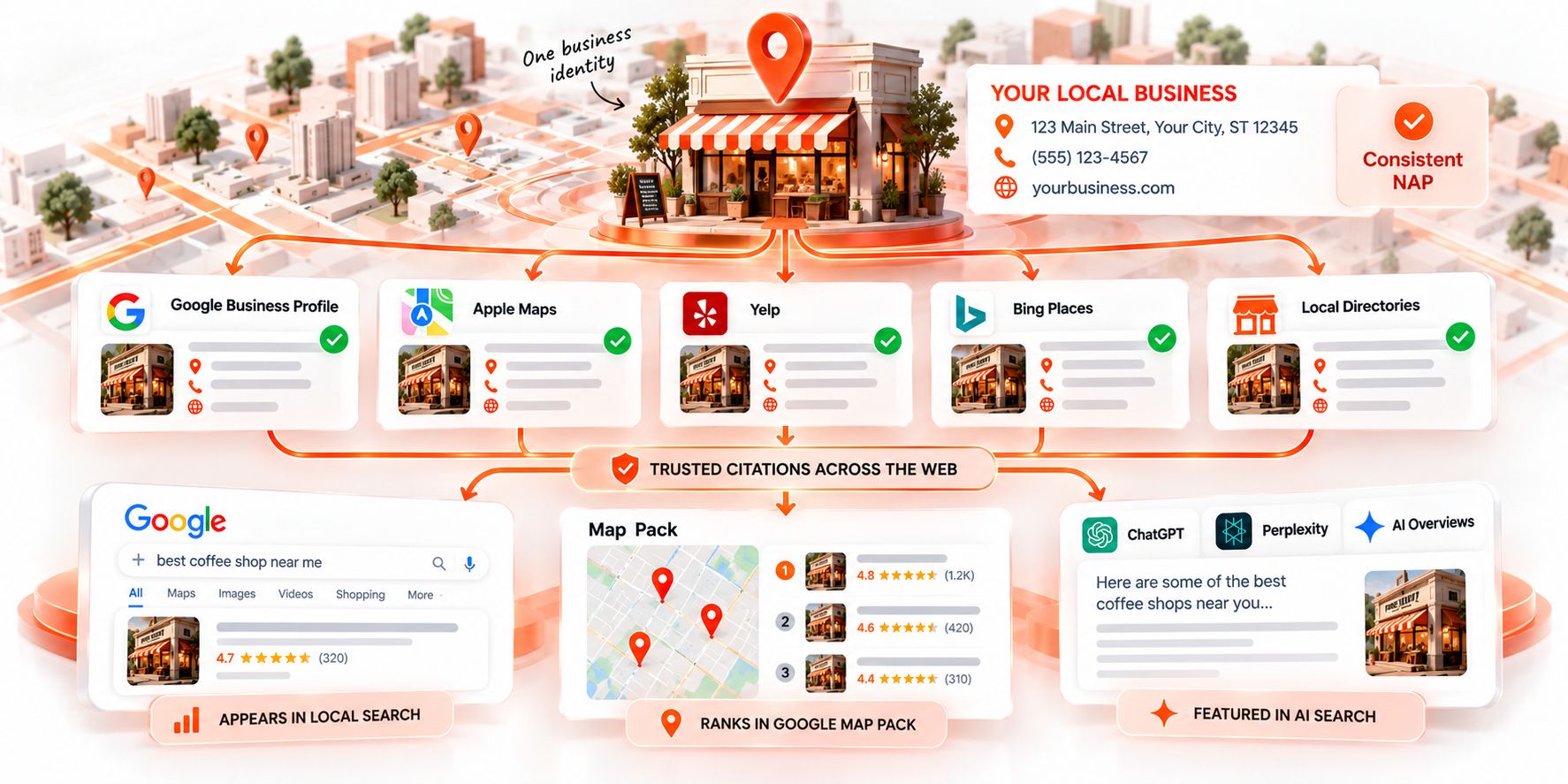
Local SEO citations are online mentions of your business name, address, and phone number. Get those right, and you turn up when someone nearby searches for what you sell.
Why does that matter so much? Because roughly 46% of all Google searches carry local intent. Nearly half of them come from people hunting for a plumber down the road, a pharmacy still open at 9 pm, the closest decent coffee. Miss those results and the customer simply books whoever did show up.
Citations are one of the quieter reasons some businesses appear and others never do. They vouch for you. They tell Google you are a real business, parked where you claim to be, and worth trusting. In 2026, they carry even more weight, because ChatGPT and Google AI Overviews now scan these same listings before they hand anyone a recommendation.
So this guide walks through the whole thing in plain English, from what SEO citations actually are to the two types, why they count, where to get them, how to build and audit them, and how they feed into AI search. Basics first.
What Are SEO Citations?
SEO citations are online mentions of your business name, address, and phone number, usually shortened to NAP. You will find them on directories, review sites, social profiles, basically anywhere your business details get listed.
Picture your NAP as the business version of an ID card. Each time it shows up online, spelled the exact same way, it stacks up a bit more proof that you exist and that you are legit.
Take a coffee shop, call it Brew Lane over in Austin. A Yelp listing with the correct address and phone is one citation. Apple Maps pulling the same details gives you another, and every accurate listing after that is one more quiet nod in your favor.
Now, the part people miss. A citation does not need to link back to your website to count. The mention on its own does work. One that also links to you is better still, and the reason why turns up a little further down.
Structured vs Unstructured Citations
There are two kinds of local citations, and you want both.
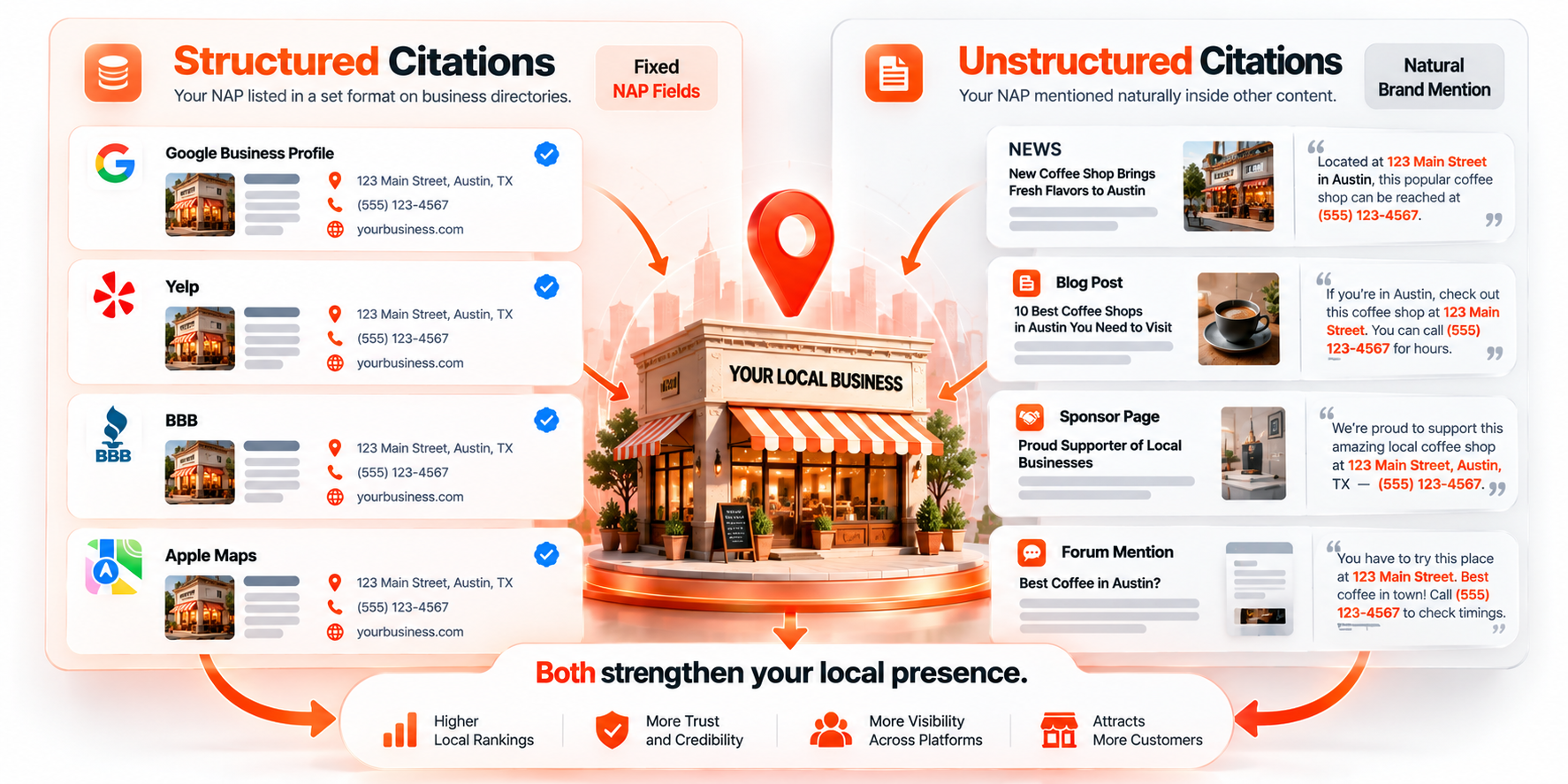
- Structured citations. Your NAP listed in a set format on a business directory. Think Google Business Profile, Yelp, or the Better Business Bureau. Clean fields for name, address, and phone.
- Unstructured citations. Your NAP mentioned naturally inside other content. A local news story, a blog post, a sponsor page, a forum thread. No fixed format, just a mention in the wild.
Structured citations are your base layer, the ones you go out and build on purpose. Unstructured mentions work differently. They tend to appear on their own as your brand gets talked about more, quietly adding a layer of trust on top of the foundation you already put down.
Why Do Local SEO Citations Matter?
Local SEO citations matter because they help Google verify your business and rank it in local search. The more consistent, trusted listings point back at you, the more sure Google feels about putting you in front of nearby searchers.
Local rankings really come down to three things Google weighs together.
- Proximity. How close your business sits to the searcher.
- Relevance. How well you match what they are actually looking for.
- Prominence. How known and trusted your business is.
Citations pour straight into that last one. When your NAP turns up correctly across dozens of sites Google already trusts, the takeaway is obvious to the algorithm: this is a legitimate, established business. And that is often what nudges you into the map pack, the little cluster of three businesses pinned to the top of local results.
There is a newer angle here too, and it is worth flagging. AI search engines have started cross-referencing your citations before they recommend anyone. When ChatGPT or Google AI Overviews finds your details listed the same way all over the web, you turn into the safe, low-risk answer to give a user. Patchy or contradictory listings do you no such favor.
Local Citations vs Backlinks: What Is the Difference?
These two get muddled constantly, so let's untangle them.
A citation is a mention of your business NAP. A backlink is a clickable link from another site to yours. Related, occasionally overlapping, but not the same animal.
- A citation can exist with no link at all. Your name, address, and phone on a directory still count.
- A backlink always includes a link, but it may say nothing about your NAP.
- Some citations happen to be backlinks too. A directory that lists your details and links to your site hands you both at once.
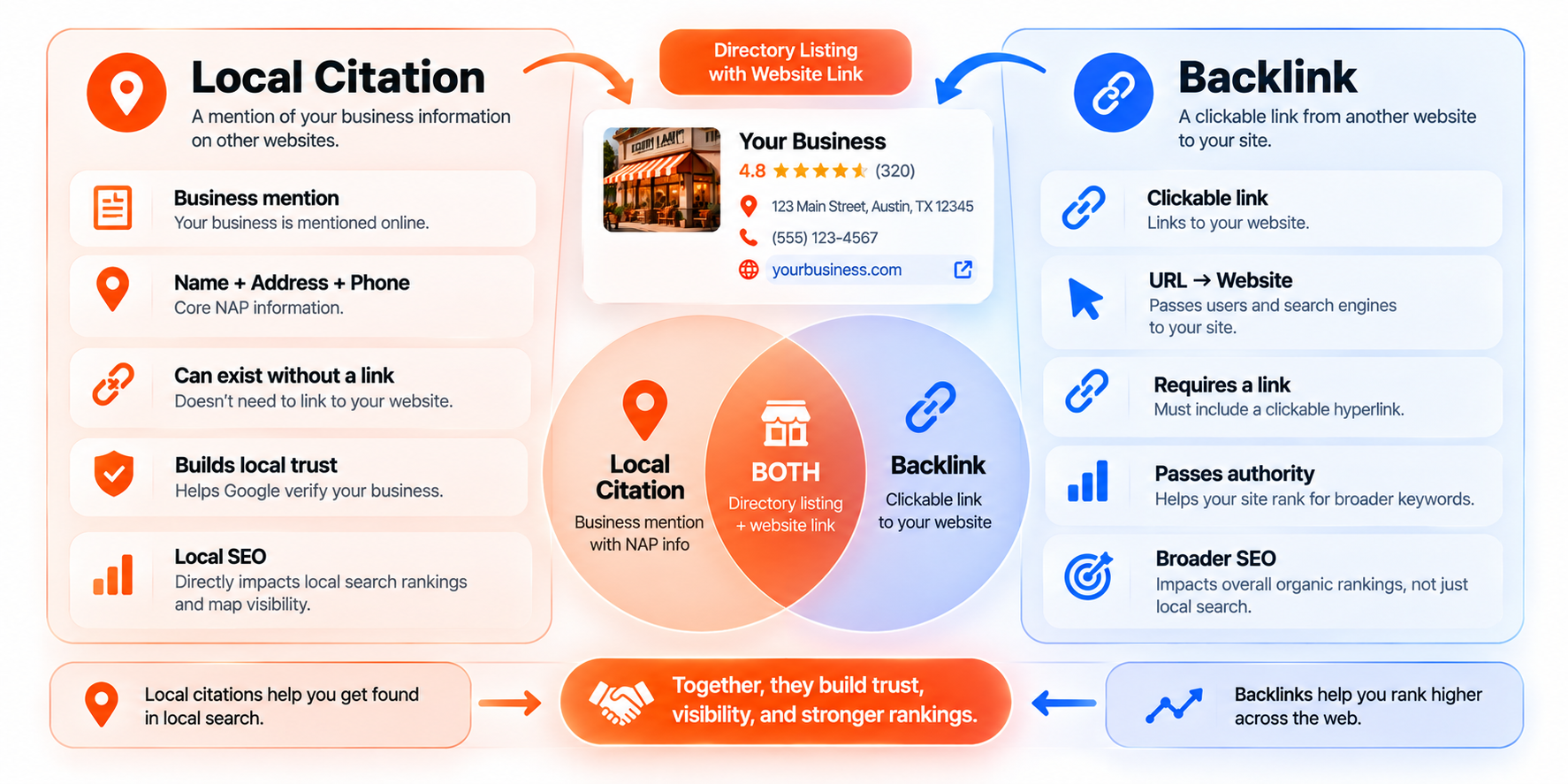
The easiest way to keep them straight is by their job. A citation exists to confirm that your business is real and where it sits. A backlink is doing something else entirely, passing authority over to your website. Local SEO runs mostly on the first, broader SEO on the second, and the businesses that pull ahead tend to bother with both.
Where to Get Local Citations (Best Sources)
Kick off with the big, trusted platforms and work your way out toward the niche ones. This order tends to save the most headaches.
Core platforms (get these first)
Data aggregators (spread your NAP wide)
Services like Data Axle, Localeze, and Foursquare push your details out to a long tail of smaller directories in one shot. One submission, and your NAP fans out across the web.
Niche and local directories (match your industry and area)
- Industry directories for your field. A restaurant guide, a legal directory, a home-services site.
- Local chamber of commerce pages and city business listings.
Do not get sucked into racking up hundreds of low-grade listings. A dozen accurate citations on sites that genuinely carry authority will run circles around a mountain of junk directories.
How to Build Citations for Local SEO, Step by Step
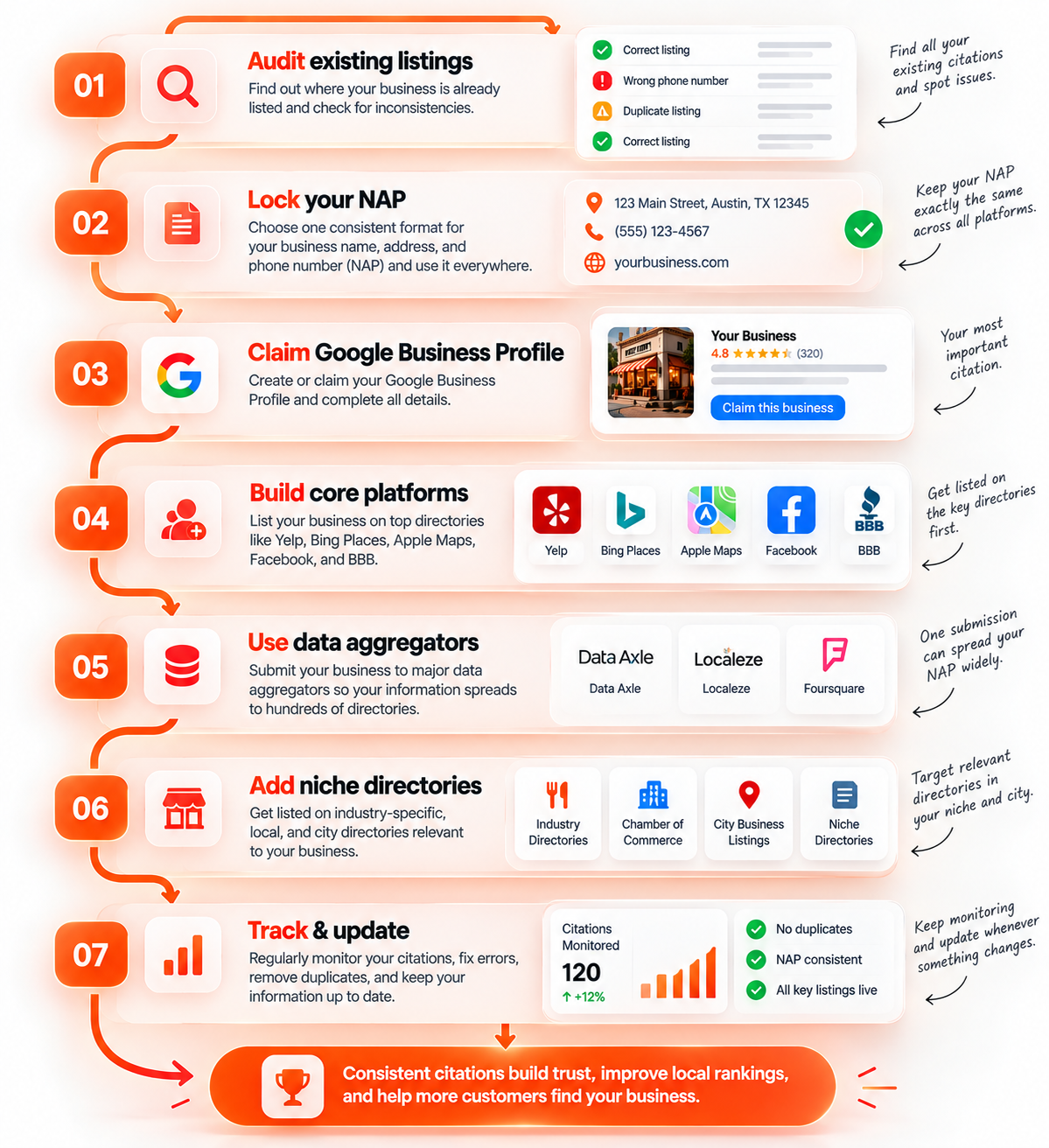
Building citations for local SEO gets a lot easier once you follow a system. Here is the sequence to work through.
- Audit what you already have. Search your business name and see which listings exist and whether they are correct.
- Lock your NAP format. Decide exactly how your name, address, and phone will appear, then use it everywhere.
- Claim your Google Business Profile. This is priority one. Fill in every field you can.
- Build the core platforms. Bing Places, Apple Maps, Yelp, Facebook, and the BBB.
- Use a data aggregator. Push your NAP out to the wider network of directories.
- Add niche and local directories. Match your industry and your city.
- Track and update. Revisit your listings as your business changes.
Work through it in this sequence, and you end up with a tidy, consistent footprint instead of a tangle to clean up later.
How to Run a Citation Audit
A citation audit is the process of finding every listing of your business and fixing the wrong ones. Inconsistent NAP details confuse Google and quietly cost you rankings.
Why bother? Picture Brew Lane relocating across town last spring. If half the internet still shows the old address, Google honestly cannot tell where you are anymore, and that uncertainty drags your ranking down without you ever seeing it happen.
Run a citation audit like this.
- Find your listings. Search your business name, phone number, and old addresses to surface every citation.
- Spot the mismatches. Hunt for wrong phone numbers, old addresses, misspelled names, and abbreviations like St versus Street.
- Kill duplicates. Two listings for the same business on one site split your signal in half. Merge or remove the extra.
- Fix and update. Correct each listing so it matches your locked NAP format.
- Recheck on a schedule. New citations and fresh errors creep in over time. Give it a look a few times a year.
A clean citation audit is honestly one of the fastest local SEO wins going. No fresh content, no new links, just repairing what is already broken under the hood.
Common Citation Mistakes to Avoid
Most citation trouble traces back to the same short list of slip-ups. These are the ones to keep an eye on.
- Inconsistent NAP. Different phone numbers or address formats scattered across sites. The number one killer.
- Duplicate listings. Two or more profiles for the same business living on one platform.
- Wrong category. Filing a coffee shop under "restaurant" muddies how relevant you look.
- Abbreviation drift. "Ste 200" here, "Suite 200" there. Tiny on its own, but it piles up.
- Old info after a move or rebrand. Dead phone numbers and past addresses still drifting around out there.
- Chasing volume over quality. A hundred spammy directories do less for you than ten trusted ones.
Local Citations and AI Search Visibility
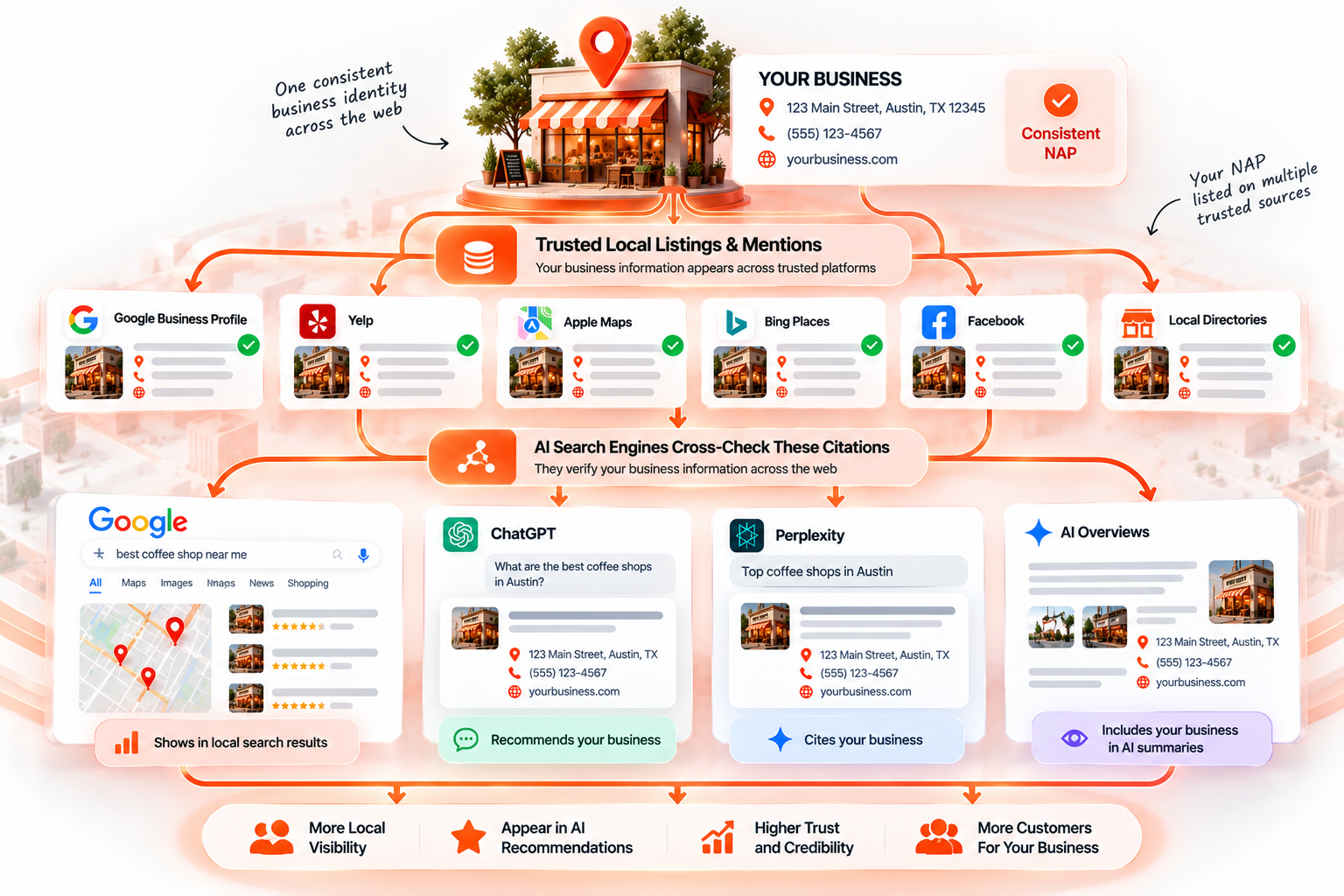
Something has shifted lately, and it is worth paying attention to. Citations used to be a purely Google game. These days they shape what the AI assistants say about you as well.
Ask ChatGPT, Perplexity, or Google AI Overviews to suggest a local business and the engine goes looking for agreement. It cross-checks whether your name, address, and other details match up across the listings, reviews, and mentions it can dig up. When everything lines up, you come across as trustworthy, and trustworthy is exactly what earns you a spot in the answer.
So the very same work that lifts your local SEO now doubles as AI visibility work. Accurate citations, a consistent NAP, and trusted mentions all pull in one direction.
And this is where it ties into something bigger. Landing in AI answers is not only about your listings. It is about being mentioned on the third-party pages and sources those engines already trust. That mention-building, getting your brand onto the pages AI engines cite, is exactly the work Anchorial takes on. Citations lay down the local foundation. Anchorial helps you surface in the answer itself.
The Bottom Line
Local SEO citations will never be the flashy part of marketing, but they quietly carry a lot of the load. List your NAP accurately on the platforms that count, keep it consistent, and give it a check-up every so often. That alone lifts you past most of your local competition.
Claim Google Business Profile, fill out the core platforms, repair whatever is broken, and steer around the mistakes above. Keep at it, and local SEO citations turn into a steady little engine, one that helps you surface on Google and inside the AI answers your customers increasingly lean on.
Frequently Asked Questions
What are local SEO citations?
Local SEO citations are online mentions of your business name, address, and phone number on other websites. They live on directories, review sites, and social profiles. Citations help Google confirm your business is real and rank it in local search results.
Are local citations still a ranking factor in 2026?
Yes, local citations are still a ranking factor in 2026. Google leans on them to verify your business and gauge its prominence. Their pull has softened over the years, but consistent, accurate citations still support local rankings, and now they feed AI search on top of that.
What is the difference between citations and backlinks?
A citation is a mention of your business name, address, and phone number. A backlink is a clickable link from another site to yours. A citation does not need a link to count, while a backlink always includes one. Some listings hand you both at the same time.
How many local citations does a business need?
There is no magic number, and quality matters far more than count. Start with the core platforms like Google Business Profile, Bing, Apple Maps, and Yelp, then add trusted niche and local directories. Ten accurate, high-authority citations beat a hundred low-quality ones.
Do local citations help with AI search like ChatGPT?
Yes. Tools like ChatGPT and Google AI Overviews cross-reference your citations before recommending a business. When your name, address, and details stay consistent across the web, you read as trustworthy, which makes you a safer answer for an AI engine to give.
What is a citation audit?
A citation audit is the process of finding all your business listings and fixing the wrong ones. It catches inconsistent NAP details, duplicate profiles, and outdated information. A clean citation audit is often the quickest way to improve local rankings.
What is the difference between structured and unstructured citations?
Structured citations list your NAP in a set format on a business directory, like Yelp or Google Business Profile. Unstructured citations are natural mentions of your business inside other content, such as a news article or blog post. You want a mix of both.
Are local citations free?
Plenty of local citations are free, including Google Business Profile, Bing Places, and most core directories. Some premium directories and citation tools do charge a fee. You can build a solid base of citations for local SEO without spending a rupee, though paid tools can save you time.